
Physical Device Identity and Lifecycle History
Hardware and network addresses have different lifetimes
An OTserver asset represents physical hardware. MAC addresses identify current network bindings within one exact site; IP addresses and names are descriptive evidence. A device can have multiple interfaces, and a chassis or module can exist without its own MAC address.
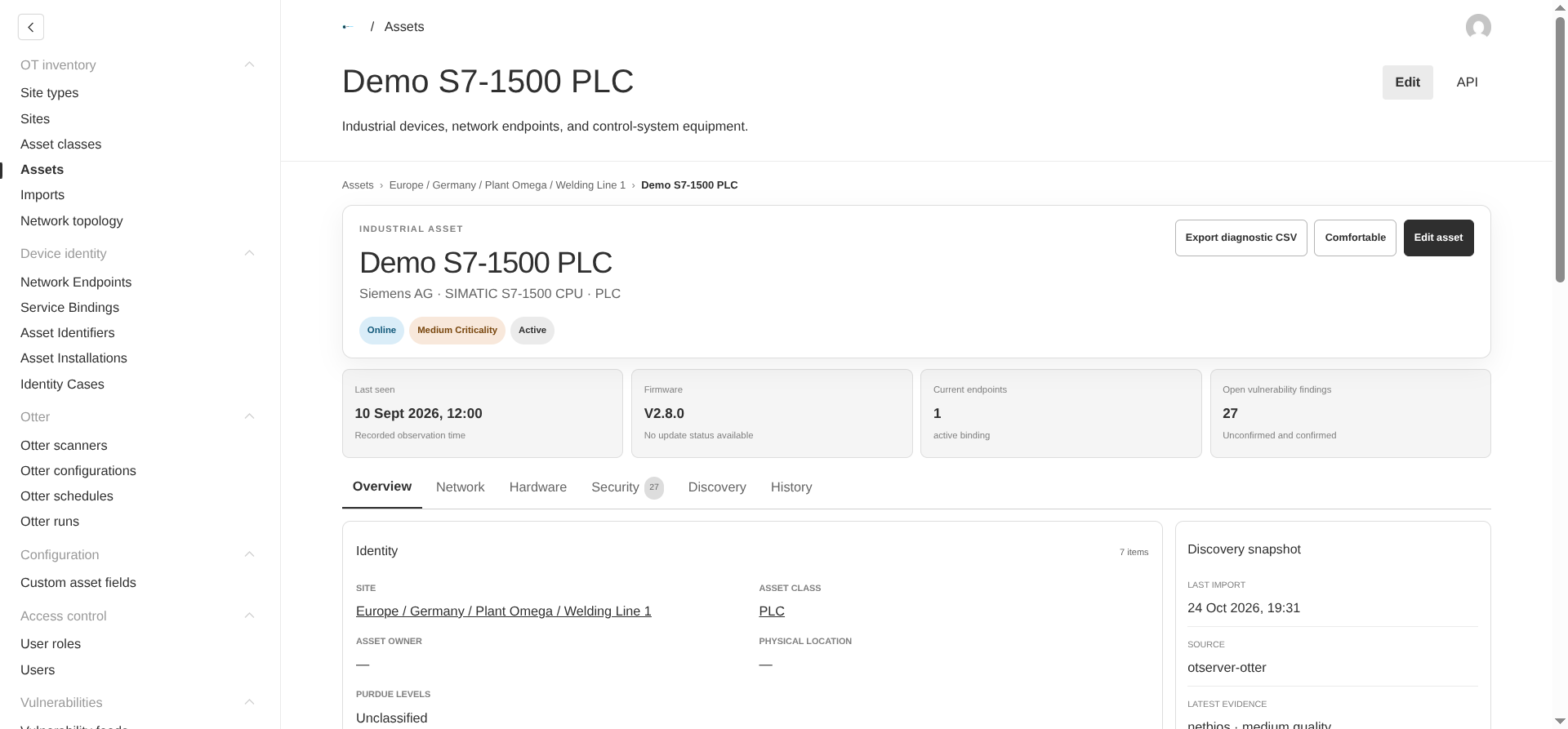
Automatic correlation requires accepted, source-qualified manufacturer and serial evidence with the correct component scope. OTserver currently accepts qualified EtherNet/IP, S7, and SNMP ENTITY-MIB evidence for this purpose. A serial-looking string, a shared IP, a nearby MAC, or a topology connection cannot authorize a physical merge.
Preserve components and uncertainty
SNMP ENTITY-MIB evidence can identify a qualified chassis, stack, or component. A module keeps its identity independently of the chassis and slot in which it is installed. Installation and endpoint assignment history preserve those relationships over time; unknown slot positions remain unknown.
PROFINET PNIO component serials remain evidence rather than becoming device-level identity. OPC UA represented assets and IEC 61850 logical devices retain their own scoped fields. When evidence cannot establish a physical identity, OTserver preserves the unresolved observation or creates an identity review case.
Review changes explicitly
Use identity actions to merge duplicate hardware records, split incorrectly associated endpoints, confirm a replacement, retire or restore equipment, close an endpoint assignment, or transfer an asset between sites. Transfers require write access to both sites. An import into another site never silently moves existing hardware.
Site hierarchy controls access inheritance, not endpoint identity: a parent site and its child remain separate MAC-binding namespaces. Review cross-site matches through explicit reconciliation.
Retirement, Trash, and deletion
Retirement records a lifecycle state. Trash is a separate deletion policy and retains hardware identity reservations so a record can be restored. Permanent deletion releases the asset’s identifiers, network endpoints, and service bindings through audited deletion, while observations and audit history remain.
Older MAC-only installations require a versioned identity migration before accepting new imports. Follow the migration instructions for the deployed manager revision, stop workers, and back up the database and uploaded files first. Current imports require a MongoDB replica set for transactional updates.